EN
EN
 AR
AR
 BG
BG
 HR
HR
 CS
CS
 DA
DA
 FR
FR
 DE
DE
 EL
EL
 HI
HI
 PL
PL
 PT
PT
 RU
RU
 ES
ES
 CA
CA
 TL
TL
 ID
ID
 SR
SR
 SK
SK
 SL
SL
 UK
UK
 VI
VI
 ET
ET
 HU
HU
 TH
TH
 MS
MS
 SW
SW
 GA
GA
 CY
CY
 HY
HY
 AZ
AZ
 UR
UR
 BN
BN
 LO
LO
 MN
MN
 NE
NE
 MY
MY
 KK
KK
 UZ
UZ
 KY
KY


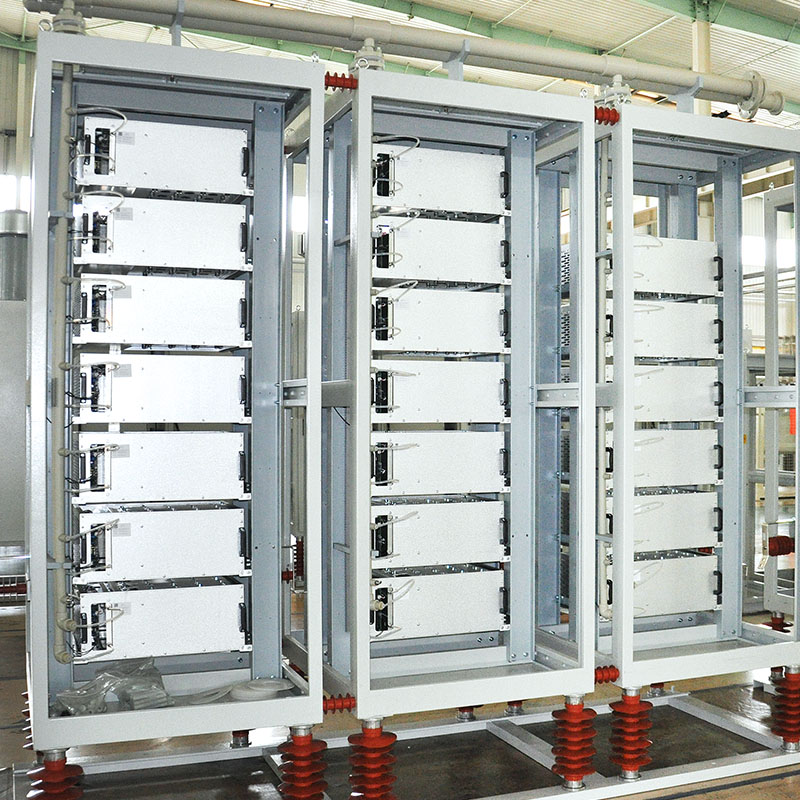
SVG Fundamentals: Fast Dynamic Reactive Power Compensation for Grid Stability
Why traditional reactive power solutions fall short in inverter-rich smart grids
Conventional reactive power compensation—capacitor banks and Static Var Compensators (SVCs)—is fundamentally mismatched to the dynamics of modern, inverter-rich grids. Mechanical switching and thyristor-based control limit their response to 40–100 ms, rendering them ineffective against sub-second voltage fluctuations from solar and wind inverters. This latency risks cascading instability during cloud transients or wind gusts. Their stepwise VAR output causes overshoot and undershoot, while capacitor banks introduce harmonic resonance hazards when interacting with inverter-generated harmonics—a critical concern given that 75% of new generation now connects via power electronics (IEC 2023 Report). Critically, none provide continuous, bidirectional reactive support across the full capacitive-to-inductive range, leaving grids vulnerable to voltage sags, swells, and relay misoperations.
How SVG achieves ≤5 ms response time and precise VAR control—core advantages over SVCs and capacitors
Static Var Generators (SVGs) eliminate these limitations using IGBT-based voltage-sourced converters that synthesize reactive current in real time. By sampling grid voltage and current 256 times per cycle, SVGs detect deviations and inject or absorb precisely calibrated VARs within ≤5 ms—up to 20× faster than legacy systems. This sub-cycle responsiveness enables seamless stabilization during renewable intermittency without mechanical wear or harmonic risk. Unlike capacitor banks, SVGs deliver smooth, infinitely variable compensation from full capacitive to full inductive output. As a result, they maintain voltage within ±1% of nominal during 90% of solar ramp events—far surpassing the ±8% deviation typical of capacitor-based systems (IEEE 1547-2018 compliance data). This precision prevents protective relay misoperations and reduces distribution losses by up to 9% in high-penetration renewable scenarios.
SVG Integration with Smart Grid Communication Architectures
IEC 61850 GOOSE messaging for sub-cycle coordination with protection and automation systems
SVGs leverage IEC 61850 Generic Object-Oriented Substation Events (GOOSE) messaging to coordinate with protection relays and automation systems at sub-cycle speed. With end-to-end latency under 4 ms, GOOSE enables SVGs to autonomously initiate reactive power injection or absorption before conventional equipment responds—stabilizing voltage during fault clearance, sudden load shifts, or inverter disconnection events. In renewable-dense networks—where inverter-based resources contribute negligible inertia—this capability is essential to prevent voltage collapse and avoid cascading outages.
SCADA and EMS interoperability via Modbus TCP, DNP3, and RESTful APIs for centralized reactive power dispatch
SVGs integrate natively into existing grid control infrastructure using industry-standard protocols: Modbus TCP for local data acquisition, DNP3 for secure, time-synchronized telemetry, and RESTful APIs for cloud-based monitoring and remote configuration. This interoperability allows transmission operators and distribution system operators (DSOs) to centrally dispatch reactive power based on real-time EMS analytics—such as dynamically counteracting localized VAR deficits during cloud transients at solar farms. Millisecond-level controllability transforms reactive power from a passive, local fix into an active, system-wide resource—optimizing voltage profiles and reducing transmission losses by up to 8%, per regional grid operator studies.
SVG as a Critical Enabler of High-Penetration Renewable Integration
Addressing local VAR deficits from solar/wind intermittency: SVG’s role at the distribution edge
At the distribution edge, high renewable penetration creates volatile, spatially localized VAR deficits—especially during solar ramp-downs or wind lulls—that destabilize feeder voltage and trigger under-voltage trips. SVGs deployed at substations or directly at renewable interconnection points resolve this with sub-cycle (<5 ms), bidirectional VAR support: injecting capacitive VARs during dips and absorbing inductive VARs during swells. At a 150 MW Texas wind park, SVGs reduced voltage flicker by 92% during grid disturbances (ERCOT Case Study 2023), enabling stable operation without costly substation upgrades or line reconductoring.
| Solution Comparison | |
|---|---|
| Traditional Capacitors | 300–500 ms response |
| Modern SVG | <5 ms response |
Meeting grid-code compliance: LVRT, Q(V), Q(f), and dynamic reactive power ramping per IEEE 1547-2018 and EN 50160
SVGs are foundational to grid-code compliance for inverter-based resources. They dynamically execute LVRT requirements—including injecting up to 150% rated reactive current during faults—as mandated by IEEE 1547-2018. Unlike fixed compensation, SVGs programmatically follow Q(V) and Q(f) curves, adjusting reactive output in real time to support voltage and frequency stability. During a 2022 California voltage dip, SVG-equipped solar farms maintained 0.95 power factor and remained online, while conventional plants disconnected. This reliability avoids derating penalties and accelerates ROI: projects recoup SVG investment within 18 months through compliance credits and avoided curtailment (NREL 2023).
Real-World SVG Deployment Impact: Performance Metrics and ROI Considerations
SVG deployments deliver measurable gains across efficiency, compliance, and resilience—translating directly into financial returns. Utility-scale installations report 12–18% reductions in transmission losses via dynamic voltage support; industrial users see 30–50% cuts in power factor penalty charges. Beyond direct savings, SVGs unlock intangible value: enhanced hosting capacity defers capital-intensive infrastructure upgrades, while sub-cycle response mitigates outage risks that cost industrial facilities an average $740k per incident (Ponemon 2023).
| ROI Dimension | Operational Impact | Financial Benefit Period |
|---|---|---|
| Energy Efficiency | 15% avg. loss reduction in distribution | 6–18 month payback |
| Compliance Assurance | Zero grid code violation penalties | Immediate |
| Resilience Dividend | 92% reduction in voltage-related downtime | 3–5 year lifecycle |
Leading utilities prioritize SVG deployment where renewable penetration exceeds 25%. When factoring in extended equipment lifespan, avoided capital expenditure, and operational continuity, SVGs consistently deliver >200% lifetime ROI—making them not just a technical upgrade, but a strategic grid investment.
FAQs
What is the main advantage of Static Var Generators (SVGs) over traditional solutions?
SVGs provide a faster response time (≤5 ms), precise VAR control, and smoother, bidirectional reactive compensation compared to traditional capacitor banks and SVCs.
How do SVGs integrate with smart grid communication systems?
SVGs use IEC 61850 GOOSE messaging for sub-cycle coordination and industry-standard protocols like Modbus TCP, DNP3, and RESTful APIs for centralized dispatch and monitoring.
What is the ROI of deploying SVG systems?
SVGs typically deliver over 200% lifetime ROI, with payback periods ranging from six months to five years due to efficiency gains, compliance assurance, and resilience enhancements.
How do SVGs help in high-renewable penetration scenarios?
SVGs address localized VAR deficits caused by renewable intermittency, providing fast, bidirectional reactive power support to stabilize grid voltage without major infrastructure costs.
Are SVGs applicable for grid-code compliance?
Yes, SVGs dynamically follow LVRT, Q(V), and Q(f) grid-code requirements, ensuring compliance with standards like IEEE 1547-2018 and EN 50160.